A Dive into Vision-Language Models
Background:
Introducing joint vision-language models focusing on how they're trained
vision-language” model has their ability to process both images (vision) and natural language text (language). This process depends on the inputs, outputs, and the task these models are asked to perform.
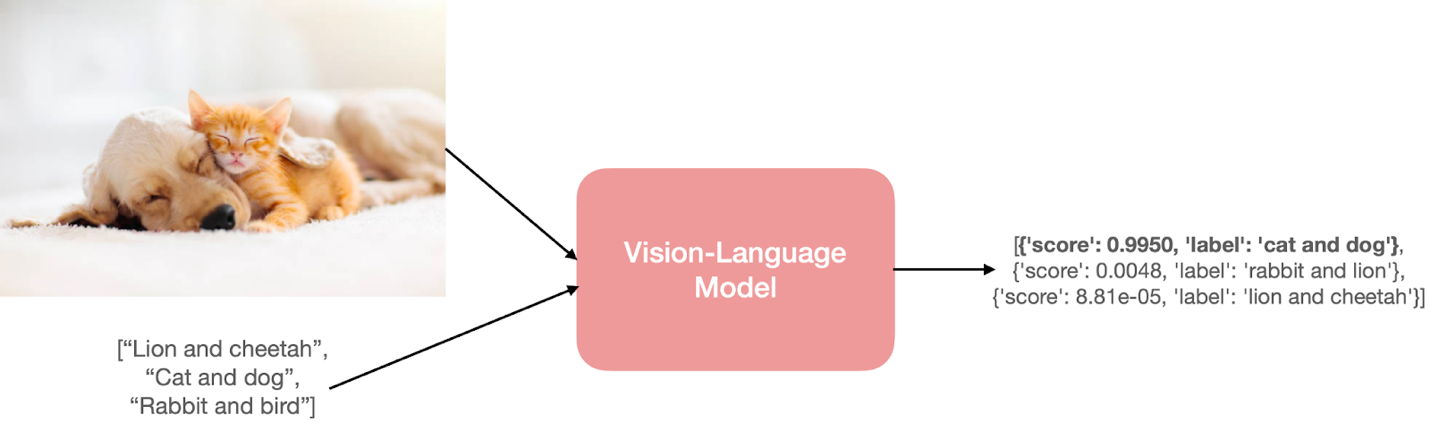
How to predict? The model needs to understand both the input image and the text prompts.
Various Form Example:
a. Image retrieval from natural language text.
- Phrase grounding, i.e., performing object detection from an input image and natural language phrase (example: A young person swings a bat).
- Visual question answering, i.e., finding answers from an input image and a question in natural language.
- Generate a caption for a given image. This can also take the form of conditional text generation, where you'd start with a natural language prompt and an image.
- Detection of hate speech from social media content involving both images and text modalities.
1. Methodology
Five core learning strategies for training vision-language models (VLMs):
- Contrastive Learning
It aims to align representations of images and text into a shared embedding space, where semantically similar pairs (e.g., an image and its caption) are close, while dissimilar pairs are far apart.
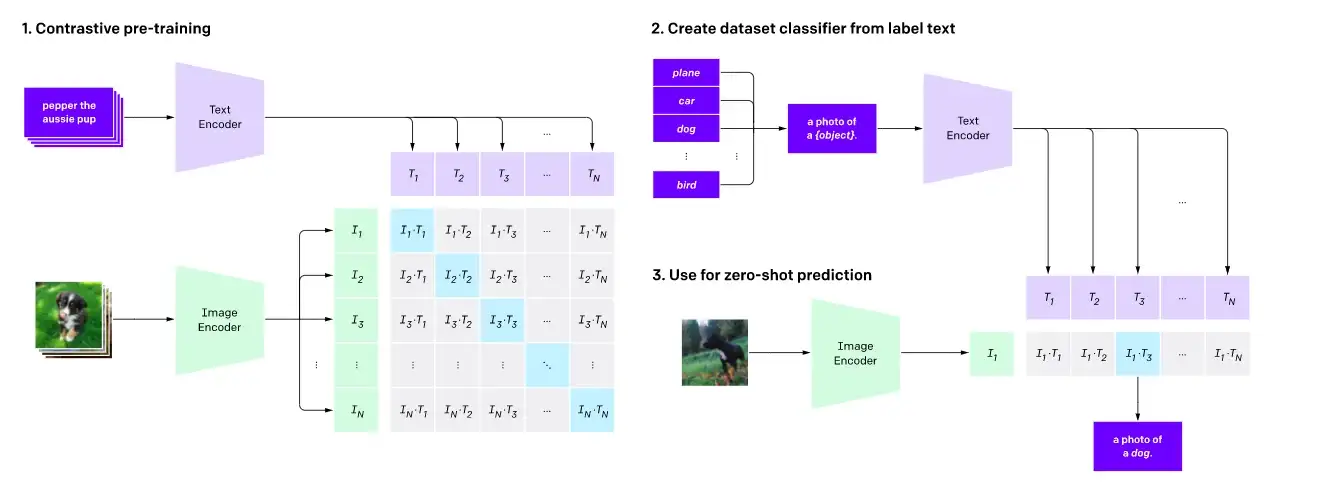
a) Goal: Align image and text embeddings into a shared space (e.g., CLIP, ALIGN).
b) Loss: Contrastive loss (e.g., cosine similarity) to minimize distance between matched pairs and maximize for mismatched pairs.
c) Strengths: Enables zero-shot generalization (e.g., image classification).
- PrefixLM
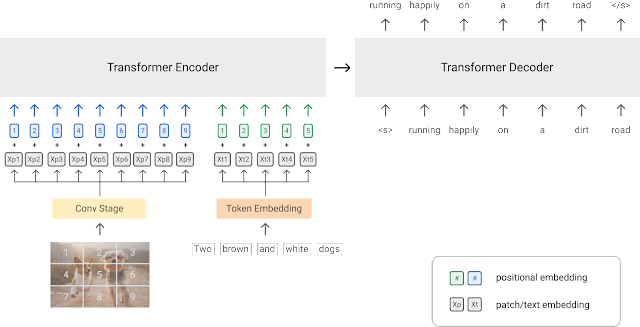
a) Process: Treat image patches as a prefix to text sequences, training autoregressive models (e.g., SimVLM, Frozen).
b) Use Case: Image captioning, VQA.
c) Variants: "Frozen" methods freeze pre-trained language models (LMs) and train only image encoders (e.g., ClipCap).
- Frozen PrefixLM
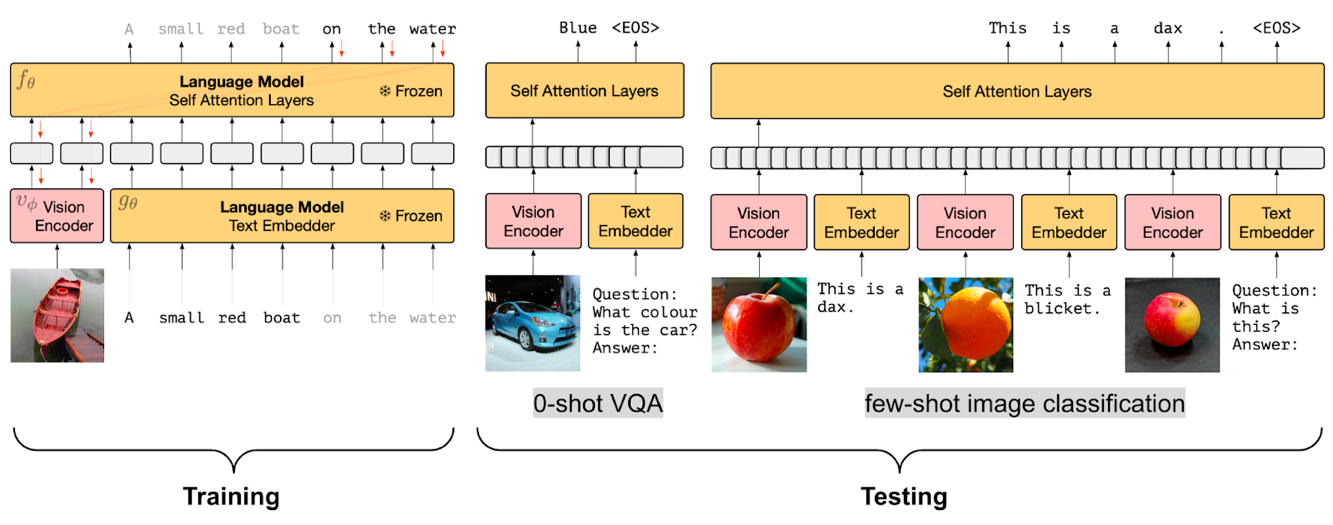
- Multi-modal Fusing with Cross-Attention
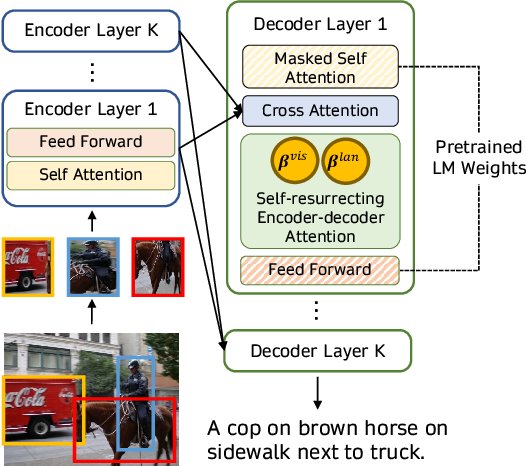
a) Mechanism: Inject visual embeddings into LM layers via cross-attention (e.g., VisualGPT, Flamingo).
b) Advantage: Balances text generation with visual context without massive datasets.
- Masked-Language Modeling (MLM) / Image-Text Matching (ITM)
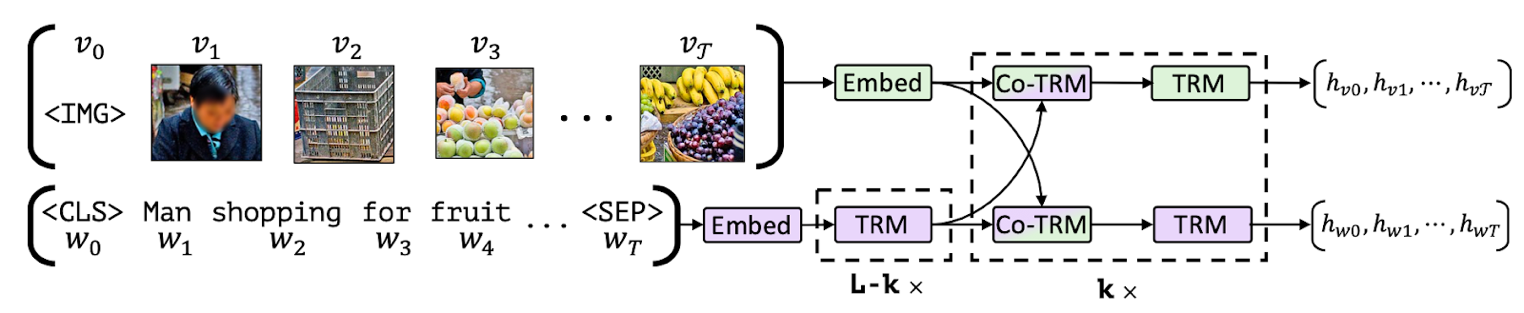
a. Tasks:
i. MLM: Predict masked text tokens using image context.
ii. ITM: Classify if image-text pairs match.
b. Models: VisualBERT, FLAVA (combines MLM, ITM, and contrastive loss).
- No Training
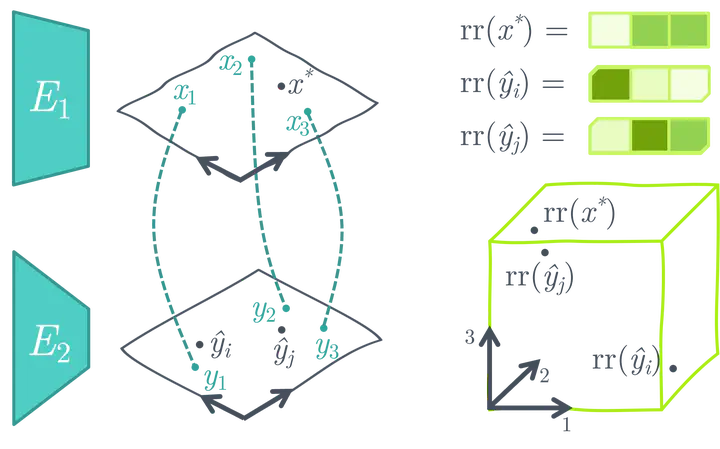
Approach: Use frozen pre-trained models (e.g., ASIF uses similarity search; MaGiC uses CLIP for iterative optimization).
2. Model Characteristics
Key models and their features:
- CLIP: Contrastive learning for zero-shot tasks; dual encoders for image/text.
- FLAVA: Combines contrastive, MLM, ITM, and masked-image modeling (MIM) for multi-task learning.
- Flamingo: Inserts cross-attention layers into frozen LMs/video encoders for few-shot learning.
- OWL-ViT/CLIPSeg: Enable zero-shot object detection/segmentation via text prompts.
- ViLT: Lightweight architecture for VQA using patch embeddings (no object detectors).
- VisionEncoderDecoder: Flexible framework (e.g., TrOCR for OCR).
Common Architectural Traits:
- Use of transformer-based encoders.
- Fusion via cross-attention or shared embedding spaces.
- Pre-training on large-scale image-text datasets (e.g., LAION-5B, COCO).
3. Gaps & Limitations
- Task Specificity: Models like PrefixLM are limited to generation tasks (e.g., captioning).
- Data Dependency: Require massive, noisy datasets (e.g., LAION-5B); alignment quality affects performance.
- Modality Constraints: Most focus on image-text; video/audio/3D integration is nascent.
- Computational Cost: Training/fine-tuning large VLMs is resource intensive.
- Robustness: Vulnerable to adversarial attacks and bias inherited from web data.
4. Future Research Opportunities
- Expanded Modalities:
- Integrate video (e.g., X-CLIP), audio, 3D data (e.g., CLIP-NeRF), and sensor inputs (e.g., robotics).
- Efficient Training:
- Few-shot/zero-shot adaptation (e.g., Flamingo’s few-shot capabilities).
- Lightweight architectures for edge deployment.
- Domain-Specific Applications:
- Medical (e.g., diagnosis via radiology reports), robotics (e.g., CLIPort for manipulation).
- Improved Alignment Strategies:
- Better handling of noisy data (e.g., ALIGN’s noise mitigation).
- Open-vocabulary detection (e.g., OWL-ViT).
- Ethical & Robust Models:
- Mitigate biases and improve fairness in multi-modal outputs.
5. Practical Takeaways
- Hugging Face Support: 🤗 Transformers provides implementations for CLIP, ViLT, CLIPSeg, and others, enabling easy experimentation.
- Emerging Applications: From medical imaging to 3D scene manipulation (e.g., AvatarCLIP), VLMs are enabling cross-domain innovation.